Report Details
Initial Publish Date
Last Updated: 17 JAN 2026
Report Focus Location: Bangladesh
Authors: NB
Contributors: GSAT
GSAT Lead: MF
RileySENTINEL provides timely intelligence and in-depth analysis for complex environments. Our global team blends international reach with local expertise, offering unique insights to navigate challenging operations. For custom insights or urgent consultations, contact us here.
NOTICE
This FLASH report provides critical analysis of rapidly evolving security conditions in Bangladesh ahead of the February 12, 2026, national elections and constitutional referendum. Given the dynamic threat environment, this update supersedes prior assessments and should inform immediate operational planning.
ACTION ITEMS
- Review all travel to Bangladesh through mid-February; assess necessity and timing of any movements
- Establish communication redundancy for personnel in-country (satellite, VPN, multiple SIM providers)
- Coordinate with local security contacts to identify safe haven locations outside polling station perimeters
- Monitor RileySENTINEL alerts for breaking developments; campaigning begins January 22
- Prepare evacuation contingencies including alternative exit routes via land borders
- Contact Riley Risk at support@rileyrisk.com for immediate operational support
SITUATION SUMMARY
Bangladesh is preparing for its 13th national parliamentary election and constitutional referendum on February 12, 2026, the first national polls since the August 2024 student-led uprising that ousted former Prime Minister Sheikh Hasina. The interim government led by Nobel Laureate Muhammad Yunus has reaffirmed the election timeline, stating elections will proceed "not a day before, not a day after" the scheduled date.
Security conditions have deteriorated significantly. Law enforcement has classified one in three polling stations as "high-risk." The government has deployed army units nationwide, established military checkpoints, and placed police on special alert. Over 555,000 Ansar-VDP personnel will be deployed across 42,766 polling stations with armed security present 24/7. The government has suspended on-arrival visas from January 15 through February 15.
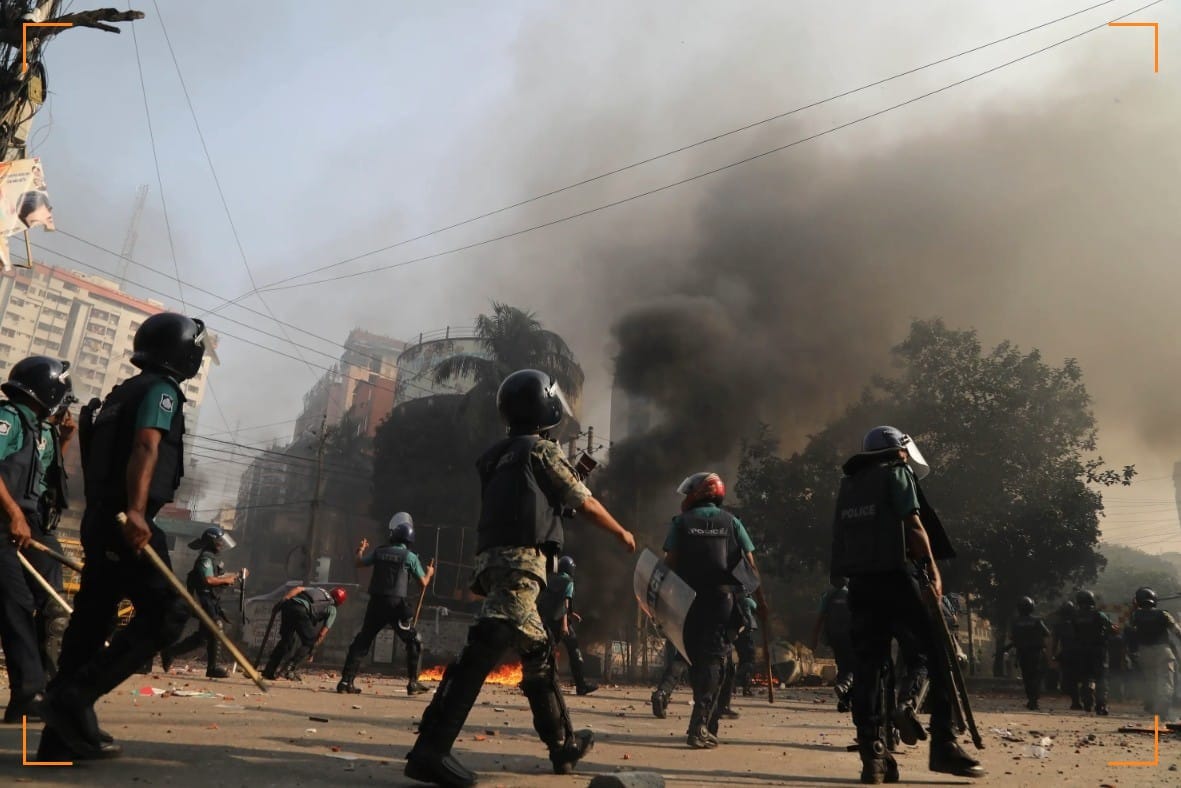
Political violence has surged dramatically. Ain o Salish Kendra documented 102 politically motivated deaths in 2025 compared to 45 in 2023. The Human Rights Support Society reported 123 deaths in 2025, up from 96. High-profile assassinations include Sharif Osman Bin Hadi, a prominent anti-Hasina activist and prospective independent candidate, shot December 11 outside a Dhaka mosque. His killing triggered violent demonstrations and attacks on media offices including Prothom Alo and The Daily Star.
The banned Awami League's exclusion from the polls creates a volatile political vacuum. The party retained approximately 30% support in pre-ban polling. Major international stakeholders including the UK Parliament and Human Rights Watch have expressed concern about electoral credibility and minority protection.
CONTEXT
The February elections represent Bangladesh's first democratic transition attempt since the violent 2024 uprising that killed an estimated 1,500 people according to Reuters. The interim government has pursued aggressive political restructuring including:
- Banning the Awami League under anti-terrorism provisions (October 2025)
- Designating the Bangladesh Chhatra League (Awami League student wing) as a terrorist organization
- Sentencing Sheikh Hasina to death in absentia for her role in 2024 killings (November 2025)
- Scheduling a constitutional referendum concurrent with elections to institutionalize governance reforms
These actions have exacerbated political tensions. BNP Chairman Tarique Rahman returned to Bangladesh in late December 2025 after 17 years abroad and has met with Chief Adviser Yunus. The main political competition is now between the BNP, Jamaat-e-Islami, and various smaller parties and independents.
Student political wings remain significant vectors of violence. Clashes between Chhatra Dal (BNP youth wing) and Bangladesh Islami Chhatra Shibir (Jamaat youth wing) have contributed to pre-election unrest. Over 1,300 illegal firearms looted during the 2024 uprising remain unrecovered despite ongoing recovery operations (Operation Devil Hunt Phase-2 has recovered 236 weapons and made over 15,000 arrests).
Violence Assessment
Political Violence Trend
| Metric | 2023 | 2025 | Change |
|---|---|---|---|
| Political deaths (ASK) | 45 | 102 | +127% |
| Political deaths (HRSS) | 96 | 123 | +28% |
| Total killings (Jan-Nov) | — | 3,509 | — |
Recent High-Profile Incidents
December 2025 – January 2026
Minority Targeting
The Rights & Risks Analysis Group (RRAG) documented 15 minority Hindu killings between December 1, 2025 and January 15, 2026. The Bangladesh Hindu Buddhist Christian Unity Council (BHBCUC) reported 51 communal violence incidents in December 2025 alone, including murders, lynchings, arson attacks on homes and temples, and property seizures.
International concern is mounting. UK Conservative MP Bob Blackman raised the issue in Parliament, stating Hindu individuals are being "murdered on the streets" with homes and temples targeted. Human Rights Watch released a January 14, 2026 report criticizing the interim government's failure to protect minorities. The EU Election Observation Mission emphasized the need for inclusive participation by religious and ethnic minorities.
The Yunus government has dismissed communal motivation, characterizing reports as "disinformation" and requesting UN assistance to counter alleged misinformation campaigns.
SECURITY MEASURES
The interim government has implemented unprecedented security preparations:
Force Deployments:
- 555,958 Ansar-VDP members across 42,766 polling stations (13 per station)
- 1,191 Ansar Battalion striking force teams (11,910 personnel) nationwide
- Army deployed with checkpoints established across the country
- River Police enhanced patrols in riverine/coastal constituencies
- BGB (Border Guard Bangladesh) deployed in border districts
Surveillance & Monitoring:
- 90% of polling centers will have CCTV coverage
- Police equipped with body cameras that cannot be manually disabled
- EU Election Observation Mission deployed 56 long-term observers across all 64 districts; will expand to ~200 observers by election day
Personnel Security:
- Armed escorts provided to senior political leaders including BNP Chairman Tarique Rahman and Jamaat Ameer Shafiqur Rahman
- 153 candidates have been issued licensed firearms
- Over 800,000 polling officials undergoing training January 22-February 7
Border & Travel:
- On-arrival visas suspended January 15-February 15
- Border area security heightened
IMPACT ASSESSMENT
HIGH RISK: Polling Station Vicinity
One-third of polling stations have been classified as high-risk. Universities hosting polling activities present elevated threat profiles given the role of student political groups in violence. Personnel should:
- Avoid polling stations and university campuses unless operationally essential
- Maintain minimum 500m standoff distance from polling sites on election day
- Anticipate violence escalation as results are announced post-February 12
HIGH RISK: Urban Centers
Dhaka and divisional cities face compounded risks from:
- Concentrated political activity and potential protest flashpoints
- Multiple high-profile assassinations in Dhaka metropolitan area
- Media offices previously targeted (Prothom Alo, The Daily Star, Chhayanaut, Udichi)
- University concentrations amplifying student group violence potential
Recommendation: Shelter-in-place capability for 72+ hours; pre-position essential supplies.
MODERATE RISK: Movement Restrictions
Expect government-imposed movement restrictions including:
- Vehicle movement controls beginning February 8
- Potential curfews in response to unrest
- Checkpoint delays on major highways
- Possible closure of internal transport links
Recommendation: Complete essential travel before campaign period intensifies (January 22); maintain flexibility for delayed departures.
ELEVATED RISK: Communication Disruptions
The government implemented internet and phone blackouts during the 2024 protests. Similar measures remain possible if widespread unrest develops. Personnel should:
- Establish satellite communication backup
- Pre-arrange check-in protocols with regional coordination
- Identify offline safe haven locations with known contacts
MINORITY-SPECIFIC RISK
Hindu communities and religious sites face elevated targeting risk through the election period and beyond. Organizations with Hindu staff or operations near minority communities should:
- Conduct welfare checks with affected personnel
- Avoid scheduling activities near temples or minority-concentrated areas
- Monitor localized social media for emerging threats
OUTLOOK
Short-term (January 17-February 12): Violence will likely intensify as campaigning begins January 22. The period between campaign launch and election day historically sees peak political violence. Target killings of candidates and activists will continue. Government security measures may suppress some violence but cannot eliminate the threat from student groups, criminal elements, and politically motivated actors.
Election Day (February 12): Expect isolated violent incidents at polling stations despite security deployments. Results announcement could trigger large-scale protests, particularly from supporters of banned parties or defeated candidates. Communications blackouts possible.
Post-election (February 13+): Transition period will determine stability trajectory. Disputed results or perceptions of electoral fraud could precipitate sustained unrest. Religious minority targeting likely to continue regardless of electoral outcomes given underlying communal tensions.
Key Variables:
- BNP electoral performance and its supporters' response
- Jamaat-e-Islami positioning and influence on incoming government
- International community acceptance of electoral legitimacy
- Government ability to contain post-election grievances
Mapping Resources


ON-THE-GROUND SUPPORT
Riley Risk maintains an active CountryACCESS program in Bangladesh with established local networks, vetted transportation and accommodation providers, and 24/7 crisis response capability. Our in-country resources have supported continuous operations since 2016 and remain fully operational through the election period.
Organizations requiring immediate support including evacuation planning, secure movement coordination, personnel welfare checks, or real-time threat updates should contact the Riley Risk team directly:
CountryACCESS subscribers receive daily SITREPs, priority FLASH alerts, direct advisor access, and pre-coordinated emergency response protocols. Contact us to discuss your operational requirements.
SOURCES
This assessment incorporates reporting from Bangladesh Sangbad Sangstha (BSS), Dhaka Tribune, The Daily Star, bdnews24, Prothom Alo, Human Rights Watch, Ain o Salish Kendra (ASK), Human Rights Support Society (HRSS), Rights & Risks Analysis Group (RRAG), Bangladesh Hindu Buddhist Christian Unity Council (BHBCUC), UK Parliament proceedings, EU Election Observation Mission briefings, and regional wire services. Ground truth is informed by Riley Risk's CountryACCESS Bangladesh program and in-country analyst network.
Expert Analysis On-Demand: Request Support
Leverage Riley Risk’s expert team for deeper analysis and tailored insights:
- On-demand consultations with our global network of advisors
- Custom reports focused on your specific operational contexts
- Proactive risk mitigation strategies for volatile environments
- In-depth analysis of regional stability factors and future outlooks
- Expedited response options for time-sensitive inquiries