Ukraine SpecialREPORT
If the War Stopped Tomorrow: A Geopolitical and Socioeconomic Forecast
Report Details
Initial Publish Date
Last Updated: 06 JAN, 2026
Report Focus Location: Europe: Ukraine
Authors: ZK, NA
Contributors: GSAT + JH, SZ, BK
GSAT Lead: MF
RileySENTINEL provides timely intelligence and in-depth analysis for complex environments. Our global team blends international reach with local expertise, offering unique insights to navigate challenging operations. For custom insights or urgent consultations, contact us here.
Summary
A sudden cessation of hostilities in Ukraine would not deliver peace. It would initiate a complex transition period demanding sustained international engagement, significant reconstruction investment, and sophisticated security management. Organizations operating in or planning to enter Ukraine must understand that post-ceasefire conditions will differ markedly from both active conflict and genuine stability.
This assessment maps the trajectory from ceasefire to stability. We examine how immediate challenges like security fragmentation, mass displacement, and $524 billion in reconstruction needs intersect with longer-term imperatives. Elections require 18 to 24 months of preparation at minimum. EU accession provides reform momentum but remains a multi-year process. Gray zone threats, including cyberattacks, disinformation, and economic coercion, will persist and likely intensify beyond any formal agreement. The assumptions that guided operations during wartime will require fundamental revision.
The Scale of the Challenge
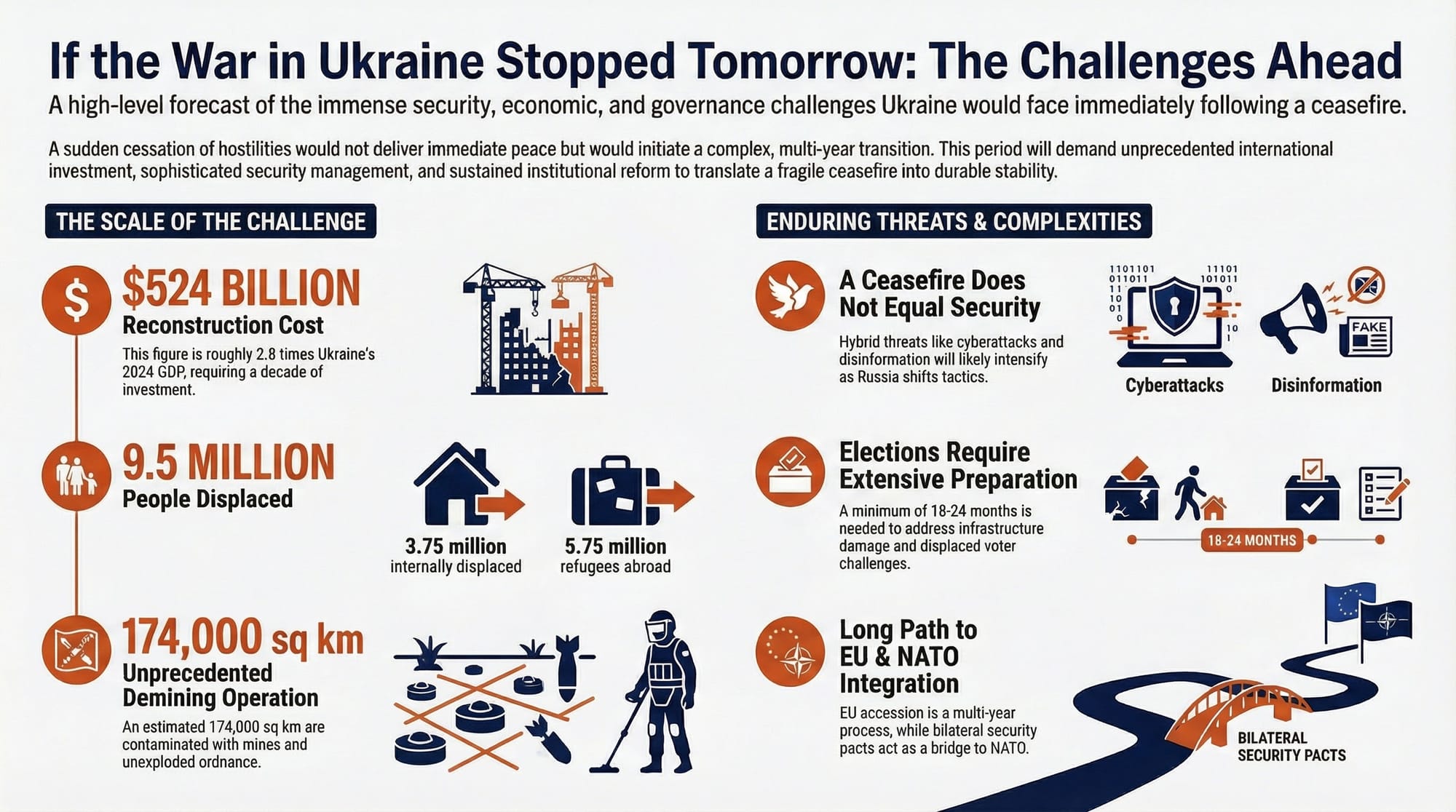
$524 billion in reconstruction costs. This figure is roughly 2.8 times Ukraine's 2024 GDP, requiring a decade of sustained investment. The World Bank's Fourth Rapid Damage and Needs Assessment confirms that approximately 72% of documented damage concentrates in frontline regions, with 2.5 million households (13% of national housing stock) damaged or destroyed.
9.5 million people displaced. Current UN reporting indicates 3.75 million internally displaced persons and 5.75 million refugees abroad. Stable return patterns will take two to five years, depending on housing reconstruction, livelihood restoration, and sustained security.
174,000 square kilometers contaminated. UN estimates suggest this territory may contain mines and unexploded ordnance, requiring years of systematic clearance before normal economic activity can resume in affected areas.
A Ceasefire Does Not Equal Security
Eastern and southern regions will require 18 to 36 months of demining, governance restoration, and security sector stabilization before conditions permit normal operations. The OSCE experience in Donbas from 2014-2022 offers a sobering precedent: the monitoring mission documented over 1.5 million ceasefire violations between 2016 and 2021 alone.
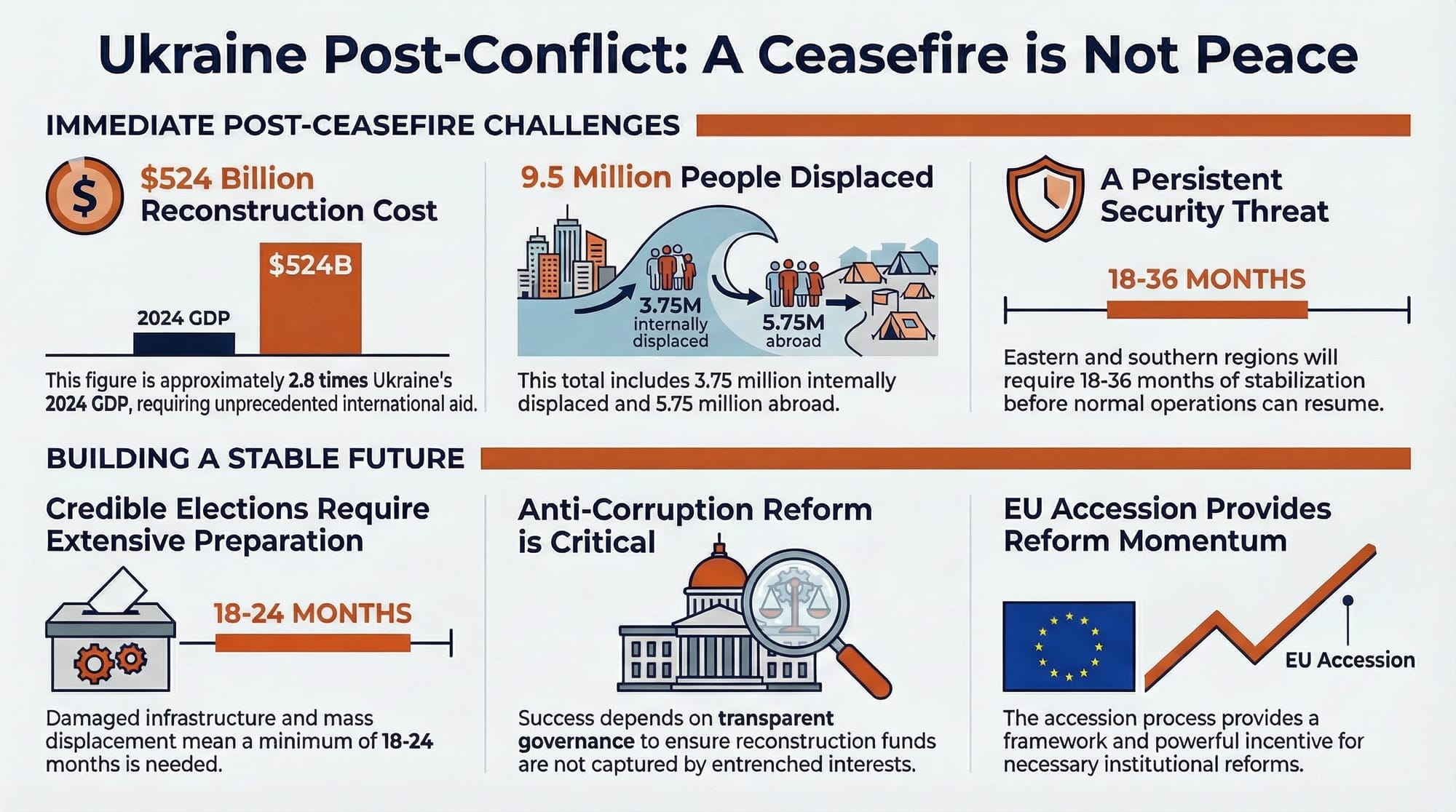
Hybrid threats will likely intensify as Russia shifts tactics. Microsoft's Digital Defense Report 2024 documented sustained Russian cyber operations targeting Ukrainian critical infrastructure throughout the conflict. These tools can be amplified under a ceasefire to maintain destabilization without triggering renewed military confrontation.
Regional Security Outlook:
Eastern Ukraine (Donetsk, Luhansk, Zaporizhzhia) remains the highest-risk zone with depopulated areas, damaged industry, and anticipated security vacuums from irregular armed groups. Key risks include local clashes and organized crime exploiting governance gaps.
Southern Ukraine (Kherson, Mykolaiv, Odesa) faces heavy infrastructure damage and population displacement, though urban areas under Ukrainian control may stabilize more rapidly. Maritime security and reconstruction will drive socioeconomic recovery.
Central and Western Ukraine is safer but still impacted by missile attacks. Post-conflict focus will center on integrating returnees and restoring economic activity, with western regions serving as the hub for recovery efforts.
Elections Require Extensive Preparation
Credible nationwide elections cannot occur immediately post-ceasefire. The challenges are unprecedented in modern post-conflict electoral history.
The displacement problem: Ukraine must enfranchise approximately 3.7 million internally displaced persons and nearly 6 million citizens abroad. For comparison, Bosnia's first post-war elections grappled with 1.5 million displaced persons; Kosovo's 2001 elections involved roughly 300,000. Ukraine's crisis exceeds both by an order of magnitude.
The interference problem: Russia's election interference is documented, sophisticated, and will intensify. The 2014 CyberBerkut attack on Ukraine's Central Election Commission—discovered less than an hour before fake results were to be announced—demonstrates the operational template. Gray zone operations extend beyond cyber to include disinformation campaigns, economic pressure timed to electoral cycles, and support for political proxies.
The infrastructure problem: The CEC must rebuild or create election administration from scratch in territories where government institutions have not functioned for years. This requires not just election-specific systems but underlying communications networks, power supplies, and administrative personnel.
A minimum of 18-24 months is needed to address these challenges. Rushing elections to demonstrate democratic legitimacy risks achieving precisely the opposite: contested results that Russia can exploit and disenfranchisement of millions.
EU Accession Provides Reform Momentum
Ukraine's EU path accelerated during wartime. The 2025 EU Enlargement Package confirmed that Ukraine completed its screening process in September 2025 and met conditions to open three negotiating clusters. Kyiv has signaled an objective to close accession negotiations by the end of 2028.
A durable ceasefire would likely amplify this momentum. The €50 billion Ukraine Facility ties financial support directly to reform benchmarks, with nearly €27 billion already disbursed. The accession process offers both framework and incentive for institutional reform, though full membership remains a multi-year trajectory contingent on sustained progress and political consensus across all 27 member states.
NATO membership faces greater political hurdles, but alternative security arrangements are advancing. Since the 2023 Vilnius Summit, Ukraine has signed 10-year bilateral security agreements with 28 partner nations. Current negotiations on a 20-point peace framework envision "Article 5-like" guarantees. These arrangements strengthen Ukraine's capacity to repel invasion rather than promising automatic allied intervention—bridges to NATO membership, not substitutes.
Implications for Operating Organizations
The transition from active conflict to post-conflict stabilization represents a critical inflection point. Security requirements do not decrease; they transform.
Immediate phase (0-6 months): Maintain wartime security protocols while updating contingency plans. Priority activities include mapping mine and UXO contamination, establishing local security networks, and conducting revised risk assessments for expansion areas.
Stabilization phase (6-24 months): Begin graduated normalization in areas demonstrating sustained stability. Establish regular review cycles for security protocols and build relationships with emerging local governance structures.
Long-term posture (2-5 years): Security requirements will depend heavily on whether the ceasefire evolves into durable settlement or remains a fragile pause. Under best-case conditions, organizations can transition toward standard emerging-market practices. Under baseline scenarios, elevated security management remains essential.
Key Findings
The security environment remains elevated. A ceasefire does not equal security. Organizations should maintain wartime security protocols during the immediate post-ceasefire phase and plan for graduated normalization only in areas demonstrating sustained stability.
The reconstruction scale is unprecedented. Success depends on transparent governance mechanisms and anti-corruption oversight. Without credible institutional reform, reconstruction funds risk capture by entrenched interests.
Displacement creates operational complexity. Stable return patterns will take years. Organizations must plan for workforce challenges and programming adjustments as populations shift.
Elections require extensive preparation. Russian interference efforts will intensify around any announced electoral timeline. Organizations should anticipate potential instability around electoral events.
EU accession provides reform momentum. The accession process offers both framework and incentive for institutional reform, creating opportunities for organizations engaged in governance support and capacity building.
UKRAINE CountryACCESS
Complete security infrastructure for organizations operating in Ukraine—delivered as a unified, integrated platform.
Replace fragmented contractors with one integrated security partner. Our Kyiv-based team delivers enterprise-grade capabilities through a proven framework—giving your organization the security infrastructure of a Fortune 500, without building it yourself.
Continue the Analysis
Download Full Report
The above summary presents the highlights of our comprehensive Ukraine SpecialREPORT. The full 34-page assessment includes detailed regional security outlooks, international donor alignment matrices, scenario-based conditional pathways, and specific policy recommendations for translating a fragile ceasefire into durable peace.
[ Free & Paid Subscribers Only: Download the Full Report Below →]
Remaining content is for members on Charter Member only.
Please subscribe to Charter Member and unlock this article and more content.
Subscribe NowAuthors

Nathan Ackerman is Managing Director of Riley Risk, specializing in complex geopolitical threats. A published author in The Guardian, Devex, and IPSB with military and intelligence expertise, he founded RileySENTINEL for actionable security insights.

GSAT (Geopolitical and Security Analysis Team) is Riley Sentinel's collective byline for team contributions or analysts requiring profile management due to sensitive work. All contributors are vetted by Riley Risk senior staff.